
The Execution Gap: Why Reps Already Know What To Do
After 20 years carrying a number, I learned knowledge was never the bottleneck. Here is why reps default to old habits and how to close the gap.
I have sat in a lot of sales kickoffs. Every one of them runs on the same quiet assumption, which is that the team is underperforming because they do not know enough yet. So we book the trainer, we buy the books, we run the role plays. And then the next quarter looks a lot like the last one. After twenty years of carrying a number and watching teams do this, I stopped believing the knowledge story.
The reps already know
Pull any rep aside who has been selling for more than a year and ask them what they should do on a stalled deal. They will tell you. Get to the economic buyer. Find the compelling reason to act now. Stop happy ears and confirm the next step in writing. They can recite all of it. I could recite all of it when I was missing quota too.
That is the part that took me years to accept. The gap on most teams is not a knowing gap. It is a doing gap. The rep knows the right move and then does something else, because the right move is on a Tuesday afternoon when they are tired, the inbox is full, and there is a renewal on fire two desks over.
Why the gap stays open
I used to think reps avoided the right action out of laziness. They do not. The gap has real mechanics, and I have watched all three of these play out on my own deals.
Knowing is comfortable, doing is exposed
Reading about handling a budget objection costs you nothing. Picking up the phone to ask a VP whether the money is actually approved, and risking a no, costs you something. Most of what we call learning is just a comfortable substitute for the uncomfortable call. I have rewritten the same email four times because writing it felt like progress and dialing did not.
The right action is usually the one you are avoiding
There is a strange pattern I noticed in my own pipeline. The deal I least wanted to look at was almost always the one that needed the next call. The avoidance was the signal. If a deal has gone quiet and I keep skipping past it in my review, it is not because nothing is wrong. It is because I already suspect what is wrong and I do not want to hear it confirmed.
Generic knowledge does not tell you what to do on this deal
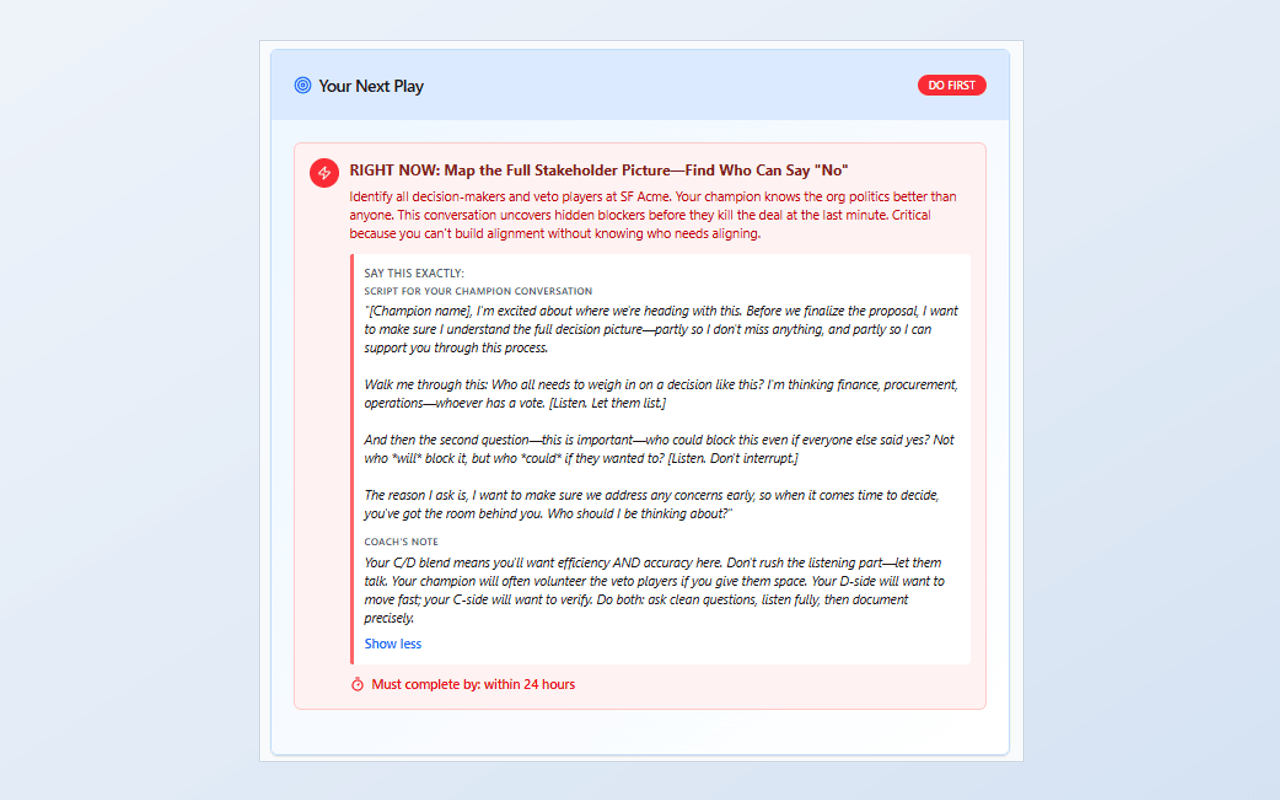
This is the one nobody trains for. A principle like understand the decision process is true and useless at the same time. It does not tell me what to do at four o clock on a Tuesday with the Acme deal sitting in proposal for twelve days while the buyer mentioned a CFO I have never spoken to. The distance between the principle and that specific situation is where reps freeze, and where most of them quietly default back to sending another check-in email.
A test I still use on myself. If I cannot name the single next action on a deal in one sentence, with a verb and a name in it, I do not actually have a plan for that deal. I have a feeling about it. Those are not the same thing, and pipeline reviews are very good at hiding the difference.
How I learned to close it
Nothing here is clever. The reps who close the gap are not smarter. They have built a few small habits that strip the deciding out of the day so the energy goes into doing. Three things made the difference for me.
Translate the principle into one specific action
Take whatever good advice you have and force it down to a sentence about this deal. Not qualify the opportunity, but call Sarah and ask whether the CFO signed off on the number she mentioned last week. Not build the relationship, but ask the champion who else has to say yes before this closes. The translation is the work. Once it is written as a concrete action with a name and a verb, the avoidance has nowhere to hide.
Do the thing you are avoiding first
I started ranking my list by discomfort instead of by ease. The call I dreaded went to the top. It is brutal for about a week and then it changes everything, because the avoided action is almost always the one carrying the most information. Either the deal is real and you just moved it, or it was never real and you just got your time back. Both outcomes beat another week of not knowing.
Keep a short list of the few actions that matter
A rep is not carrying two deals. They are carrying thirty or forty, each with contacts and stages and history. Asking someone to hold all of that in their head every morning and then choose well is asking them to burn the energy they needed for the actual selling. So I kept the list short. A handful of actions a day, the ones most likely to move real money, written down the night before so the morning has no decision left in it. That is the whole system. A small, honest daily list of the few highest-value moves, and the discipline to work it before the inbox sets the agenda.
What this looks like for a manager
If you run a team, the lever is not more content. Your reps are already full. The lever is making the next specific action visible and getting them to do the hard one. In a one on one I stopped asking how is the pipeline looking, because the honest answer is a story. I started picking one deal and asking three questions. What is the single next action here. What exactly will you say. When will you do it. If they cannot answer all three, that is the coaching, and it is worth more than any framework you could teach them that week.
Most of what we built into the NOVA-6 analysis in Opsight came out of this exact frustration. The point was never to teach reps more theory. It was to take everything a deal is telling you and hand back the few specific actions worth doing on it today, so the energy goes into the call instead of into deciding which call to make.
The honest question
I have watched reps ace a training on Friday and revert to old habits by the following Wednesday. It is not a memory problem. The knowledge was there the whole time. So the question I keep coming back to, for myself as much as for any rep I have coached, is simpler than anything a course will ask you. You already know what the deal needs. Are you going to go do it today, or are you going to read about it again?
The whole NOVA-6 framework is free: six dimensions, the exact questions elite reps ask, and a one-page blueprint you can pin to your desk.
Explore the free NOVA-6 academy →Key takeaways
- For experienced reps the bottleneck is doing, not knowing. They can recite good selling and still default to old habits when a real deal is in front of them.
- The gap stays open because knowing is comfortable, the right action is usually the avoided one, and generic advice never tells you what to do on this deal at this moment.
- Close it by translating principles into one concrete next action with a name and a verb, doing the avoided thing first, and keeping a short daily list of the few moves that matter.
- Managers should coach the specific next action in one on ones, not the pipeline in general. What will you say, and when will you do it.
Keep learning — free, no signup
The same field-tested playbook this article draws from, in the free Sales Academy.
Ashish Kohli
Ashish spent two decades carrying a sales quota and managing reps across wireless, B2B, and enterprise, and taught sales at the college level. He's building Opsight, an AI sales coach that adapts to how each rep actually sells instead of coaching everyone the same way.
Get the next one in your inbox
A short, practical note on sales coaching and deal health every week or two. No fluff, no spam, unsubscribe anytime.
No spam. Unsubscribe anytime.