
CRM, Call Analysis, Coaching: Three Different Jobs
Your CRM stores what happened. Call tools review what was said. Coaching tells a rep what to do next. How to tell which job a tool actually does.
I have sat through a lot of tool demos in twenty years of selling, and most of them sounded like they were solving the same problem. The CRM rep, the call-recording rep, and the coaching rep all used words like visibility and insight and pipeline health. On the surface they blur together. Underneath, they are doing three jobs that have almost nothing to do with each other.
If you are a sales leader trying to figure out what to buy next, the first useful move is to stop asking what a tool does and start asking which of the three jobs it does. Once you can name the job, the vendor pitch gets a lot easier to read.
The three jobs, plainly
Here is how I separate them in my own head. Each one answers a different question, and each one is timed differently. Storage looks at the past as a record. Call analysis looks at the past as a transcript. Coaching looks at the deal you have open right now and the rep who owns it.
Job one: storage. What happened.
This is the CRM. Salesforce, Pipedrive, HubSpot. It holds the account, the contacts, the stage, the close date, the notes a rep bothered to type. It is the system of record, and you cannot run a team without one. When I built a B2B team early on with no real playbook, the thing that hurt most was not having a clean record of where every deal stood. A CRM fixes that.
What a CRM does not do is interpret any of it. It will happily tell me a deal has sat in stage three for forty-five days. It has no opinion about whether that is normal, who went quiet, or what the rep should send tomorrow morning. That is not a flaw. Storing is the job, and it does the job.
Job two: call analysis. What was said.
This is the recording and conversation layer. It captures the call, transcribes it, and pulls patterns out of the words. Talk-to-listen ratio, which competitor got mentioned, how long the rep spent on price. I have used this kind of tooling and found it genuinely useful for one thing: it shows me what actually came out of a rep's mouth instead of the cleaned-up version in their deal notes.
But it is still looking backward. It analyzes the call that already ended. A report that says the rep talked seventy percent of the time on discovery is a fair observation. It is not a plan for the next call, and it is not adapted to the specific buyer the rep is about to meet. Someone still has to turn the observation into a move.
Job three: coaching. What to do next.
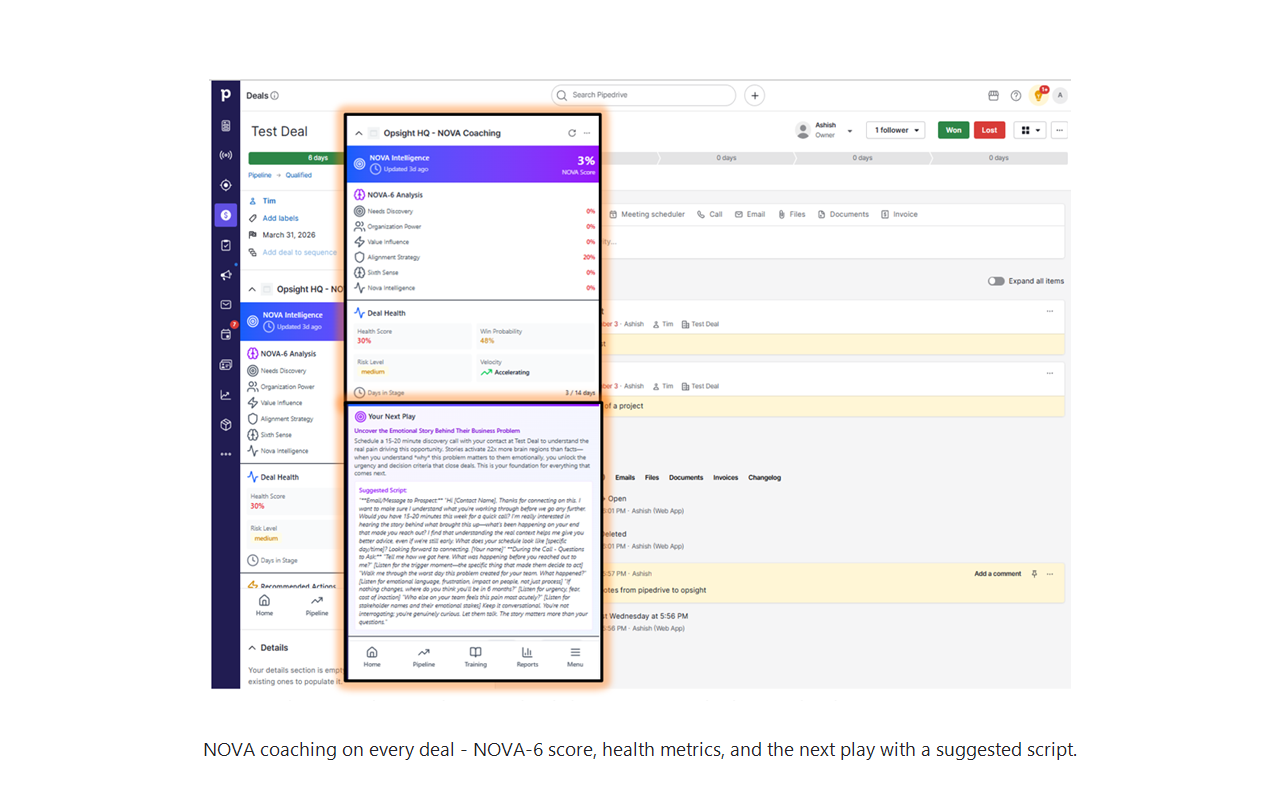
This is the layer most stacks are missing, and it is the one I care about most. Coaching takes the record from storage and the patterns from call analysis, points them at the live deal, and tells the rep what to do next. Not at the quarter. At this account, this week, this open thread.
The honest test for whether something is coaching: does a rep finish reading it knowing their next action? If the output is a dashboard the rep has to interpret, that is still analysis wearing a coaching label. Reps do not have time to be their own analysts. They need the answer, in their language, for the deal in front of them.
| Job | Question it answers | Time horizon |
|---|---|---|
| Storage (CRM) | What do we know about this deal? | The record, kept over time |
| Call analysis | What was said on the call? | The conversation that already happened |
| Coaching | What should this rep do next? | The live deal, right now |
Why you still need the third even with the first two
I have watched teams with a beautiful CRM and a full call-recording subscription still miss number, and the reason is almost always the same. The data was there. The insight was there. Nobody turned either one into an action the rep actually took on a specific deal.
Storage gives you a record. Analysis gives you an observation. Both stop one step short of the moment that decides the deal, which is a rep sitting down to write the follow-up and not knowing what to write. That step is the whole job of coaching, and it is the step that does not happen on its own just because you bought the first two tools.
The other thing the first two cannot do is account for the rep. A CRM treats every rep the same. A call report treats every rep the same. But a direct, fast-moving rep needs a blunt next step with no preamble, and a more cautious, detail-driven rep needs the reasoning and the evidence before they will act. This is where I lean on the NOVA-6 read of how a rep is wired, so the same deal advice lands differently depending on who is receiving it. Inside Opsight that adaptation is the coaching layer's actual work, not a setting.
From experience
Late in my career I was finally assigned a real mentor, an operator who had spent decades building his own system. He did not hand me dashboards. He would look at a stuck deal and tell me the next thing to do, and he told it to me differently than he told the rep next to me, because we were not the same person. That is the job I could never get from a tool that only stored data or only graded my calls. Most reps never get that mentor, and most managers do not have the hours to be one for eight people at once. That gap is the reason the third job exists.
How to read a vendor who blurs the line
Vendors will reach across jobs, because the bigger the claim, the bigger the deal. A CRM will say it has insights. A call tool will say it coaches. Two questions cut through almost all of it.
First, ask the vendor to show you the actual output for one specific open deal, not a category average. If what comes back is a chart or a score, you are looking at analysis. If what comes back is a sentence a rep could act on this afternoon, you are closer to coaching.
Second, ask whether the output changes based on which rep receives it. Storage and analysis produce the same artifact for everyone. Real coaching does not, because the right next move depends on the person making it. If the demo gives every rep the identical recommendation, the tool is doing one of the first two jobs and calling it the third.
Putting it together
These three are not rivals. The CRM stays the system of record. The call layer keeps surfacing what was actually said. The coaching layer reads both, watches the live deal, and hands the rep a move. Each one feeds the next, and the work only really pays off at the end of that chain, when a specific rep does a specific thing on a specific account because something finally told them what it was.
So before you add the next tool, name the job it does. Then ask which of the three jobs your team is quietly going without. In most stacks I have seen, the missing one is not storage. Which job is actually empty on your team?
The whole NOVA-6 framework is free: six dimensions, the exact questions elite reps ask, and a one-page blueprint you can pin to your desk.
Explore the free NOVA-6 academy →Key takeaways
- Storage, call analysis, and coaching are three different jobs that vendors describe with the same words.
- The CRM records what happened. Call tools review what was said. Both look backward.
- Coaching takes that record and tells a specific rep what to do next on a live deal.
- You can own the first two and still go without the third, which is where deals are actually decided.
- To spot the real job, ask for the output on one open deal, and ask whether it changes per rep.
Keep learning — free, no signup
The same field-tested playbook this article draws from, in the free Sales Academy.
Ashish Kohli
Ashish spent two decades carrying a sales quota and managing reps across wireless, B2B, and enterprise, and taught sales at the college level. He's building Opsight, an AI sales coach that adapts to how each rep actually sells instead of coaching everyone the same way.
Get the next one in your inbox
A short, practical note on sales coaching and deal health every week or two. No fluff, no spam, unsubscribe anytime.
No spam. Unsubscribe anytime.