
Why I Built an AI Sales Coach After 20 Years of Selling
I carried a quota for two decades, taught sales as an adjunct professor, then built Opsight on nights and weekends. This is the story of why.
I started working young. There was a stretch where I walked close to a mile to get to a job, and I remember doing it in the rain more than once. I tell you that not because it is dramatic, but because selling has been the through-line of my whole working life. I have sold wireless in a retail store. I have sold B2B. I have sold enterprise technology. I carried a quota for about twenty years, and for a good chunk of that I still do, because I never fully left the floor.
Along the way I was an individual contributor, then a manager, and for five semesters I taught Sales and Sales Management as an adjunct professor. Building Opsight pulled on every one of those roles at once. So this is the story of why I built it, and what I kept bumping into for years before I finally tried to fix it.
The mentor I got late
For a long time I was figuring sales out alone. I built a B2B team without a real playbook, learning by losing deals and slowly working out what I had done wrong. Then, fairly deep into my corporate career, I was assigned my first real mentor. He had spent decades selling, and he did not just hand me tactics. He handed me a way of thinking.
He taught me to look at pipeline across the next few quarters instead of just the one I was sweating. He drilled follow-up into me until it was a habit and not a scramble. He showed me that buyers are wired differently and that the same pitch lands or dies depending on who is across the table. And he always told me the why behind a move, never just the move.
That relationship changed my trajectory. He has been retired for most of a decade now and he still picks up when I call. What stuck with me, though, was a quieter realization. Most reps never get a mentor like that. Not because good mentors do not exist, but because most reps do not know to ask, most companies do not build the culture for it, and most leaders simply do not have the hours. The reps who get that guidance pull ahead. Everyone else figures it out through trial and error and a pile of deals that did not have to be lost.
The 1:1 that never went anywhere
When I became a manager, I felt the other side of this. I would sit in a 1:1 staring at a dashboard with more metrics than I could use. I could see what was off. Activity was thin, a deal had gone quiet, a number was short. What I could not do was tell the rep in front of me exactly what to do next on a specific deal.
So the conversation would go the way those conversations go. How can I help. All good. Well, let me know. And then nothing would change. The same objection would trip the same rep up the next week. I could not be on every call. I could not coach two dozen people through every moment of doubt. The data was sitting right there and the direction was missing.
That gap is where the whole idea started. What if a rep could get the kind of guidance my mentor gave me, but on a regular Tuesday, on a real open deal, without needing to be lucky enough to land the right boss.
Building it myself
I am not an engineer by training. I did not hire a dev shop or describe the thing to a team and wait. I built Opsight myself, on nights and weekends, while still holding down my day job. The way I could do that as a non-engineer was by leaning hard on AI tools to turn what was in my head into working software. There is a real irony there that I think about often. I was using AI to build a coaching product because I was worried reps were not getting enough human coaching.
It was not clean. I thought I was close to done and then started over more than once because the thing I had built did not actually coach, it just reported. There were nights I wanted to quit. What kept me in it was that I was not guessing at the problem. I had lived inside it for twenty years.
What I tried to pour into it was specific. The field experience across wireless, B2B, and enterprise. The patterns I saw teaching it semester after semester, when you have to explain not just what works but why it works to a room of people who will challenge you. And the systems I actually used myself when I was carrying a number.
The part I care most about
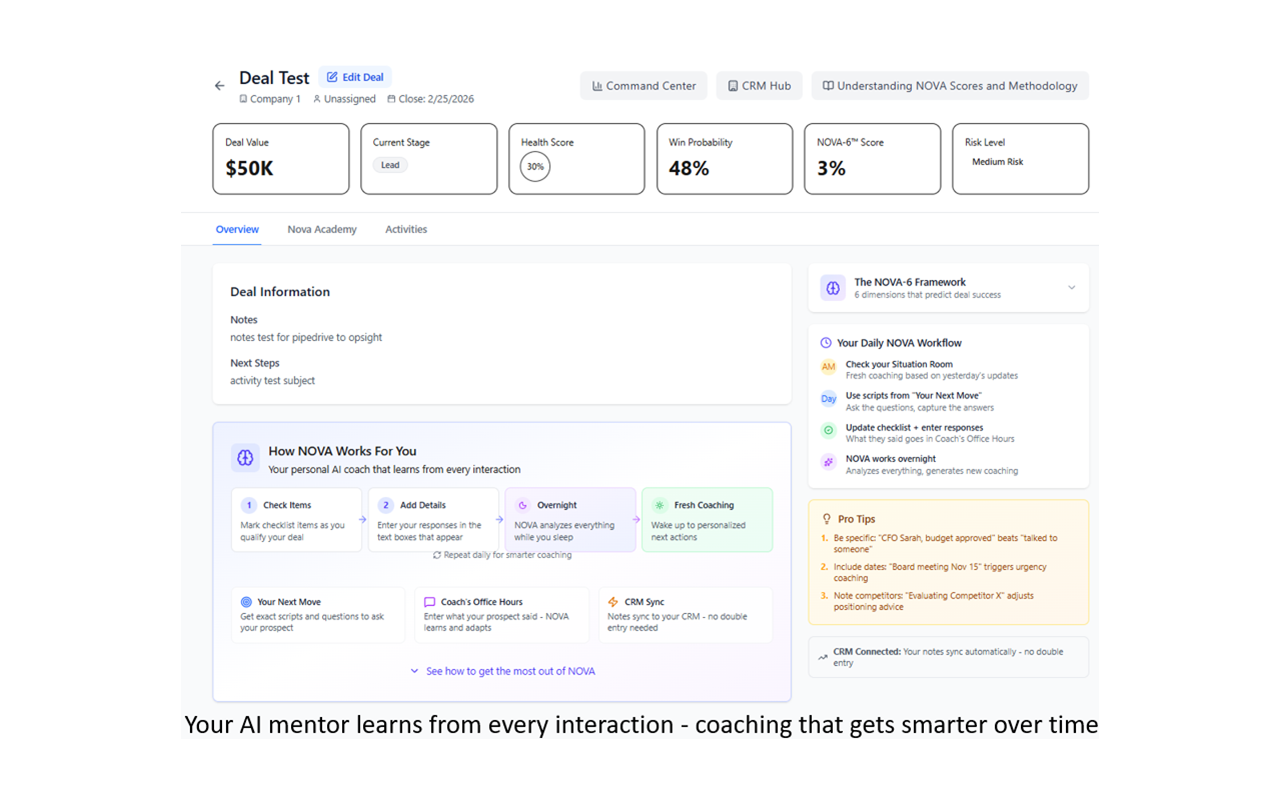
The framework I distilled out of all of that, I call NOVA-6. I am not going to turn this into a feature tour, because that is not really the point of writing this. The point is the belief underneath it.
I do not think AI should sell for you. I do not even think it should replace your judgment as a manager. The way I think about it is that the human is the coach and the software is the assistant coach. It can scan across fifty deals and surface the signal you would have missed on the one you were too busy to open. It can show its work, so when it flags a deal as shaky you can see exactly why and then decide for yourself whether you agree.
The piece I am most attached to is that coaching has to bend to the person. A rep who is direct and impatient does not want feedback delivered the way you would give it to someone who is steady and careful. I watched the exact same advice land and bounce depending on how a rep was wired, which is why the coaching adapts to DISC style instead of treating everyone like a copy of the manager. The old failure mode is a manager coaching every rep the way the manager would want to be coached. That was a mistake I made, and I built against it on purpose.
If you manage a team, try this without any software. Before your next 1:1, write down the one thing you would actually do on the rep's most important open deal if it were yours. If you cannot, that is the gap. It is the same gap I stared at for years.
What I am still sitting with
I am still selling. The tool did not replace me. On a good week it makes me more consistent and a little less likely to let a deal go dark. That is honestly all I wanted it to do for me, and all I want it to do for anyone else.
I built Opsight for the version of me who was running a B2B team alone with no playbook, and for the manager I became who could see the problem on the screen but not the fix. I had to wait a long time and get a little lucky to find the mentorship that changed how I sell. I keep coming back to one question. If that kind of guidance had been sitting next to me from the start, instead of arriving a decade in, who would I have become as a seller. I do not know. But I would have liked the chance to find out, and I think every rep deserves it.
The whole NOVA-6 framework is free: six dimensions, the exact questions elite reps ask, and a one-page blueprint you can pin to your desk.
Explore the free NOVA-6 academy →Key takeaways
- Most reps never get a strong mentor, and the ones who do tend to pull ahead.
- Managers can usually see what is wrong on a dashboard but struggle to say what to do next on a specific deal.
- Coaching has to adapt to how each rep is wired, not how the manager would want to be coached.
- I built Opsight on nights and weekends as a non-engineer, using AI tools, to put twenty years of selling into something that guides a rep day to day.
Keep learning — free, no signup
The same field-tested playbook this article draws from, in the free Sales Academy.
Ashish Kohli
Ashish spent two decades carrying a sales quota and managing reps across wireless, B2B, and enterprise, and taught sales at the college level. He's building Opsight, an AI sales coach that adapts to how each rep actually sells instead of coaching everyone the same way.
Get the next one in your inbox
A short, practical note on sales coaching and deal health every week or two. No fluff, no spam, unsubscribe anytime.
No spam. Unsubscribe anytime.