
How to Prioritize When Every Deal Feels Urgent
Every deal feels urgent. Most are just loud. How I separate winnable deals from happy ears and spend my best hour where it actually pays.
Twenty years selling, and I still catch myself doing it. I open the pipeline, see twelve deals, and every one of them feels like it needs me right now. The buyer who emailed at 11pm. The renewal my manager keeps poking me about. The new logo I'm a little too excited about. They all wave their hands at the same time.
So I'd do what most reps do. Start at the top of the list, work down, give each deal roughly the same slice of attention. Five minutes here, a quick follow-up there. By the end of the day I felt busy. Some days I even closed something. Plenty of other days I just spread myself thin across deals that were never going to move, while the one deal that actually deserved a full hour got the same five minutes as the rest of them.
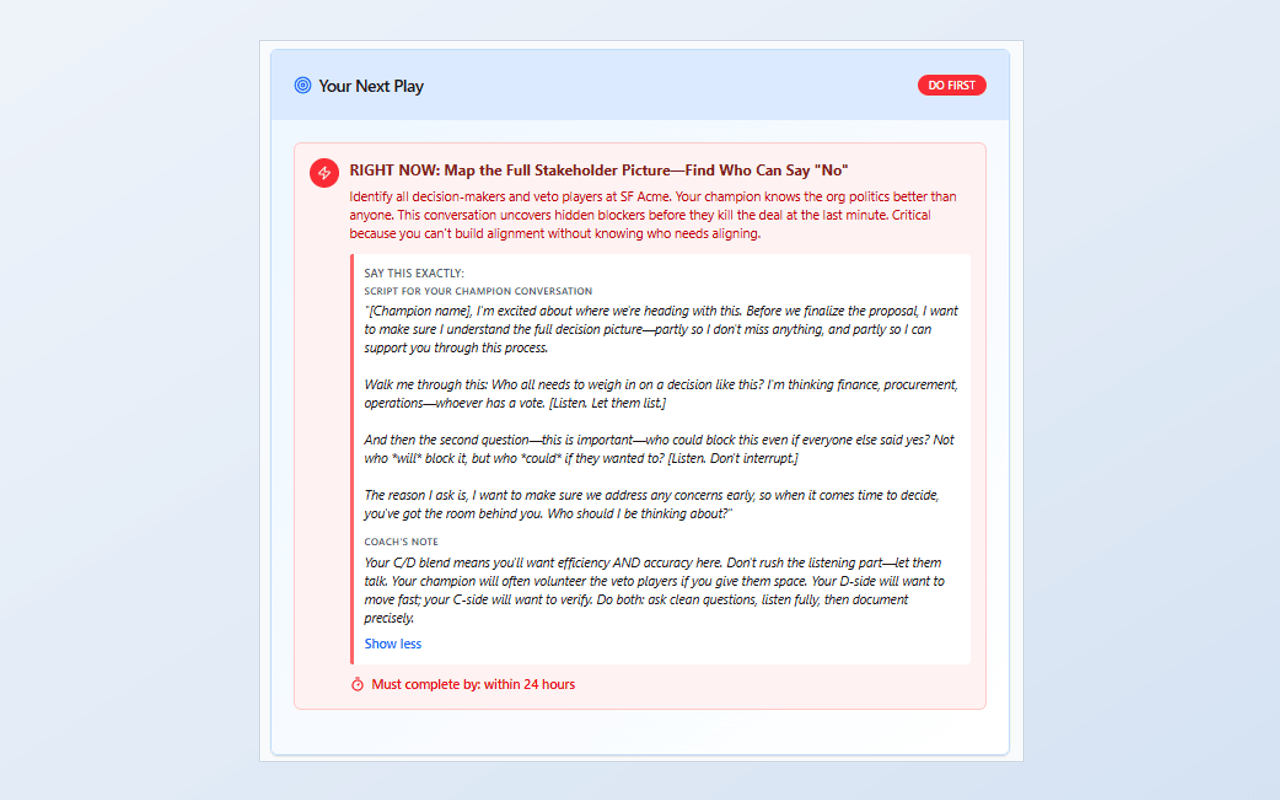
Urgent usually means loud
Here is what took me too long to figure out. The deals that feel most urgent are almost never the most important ones. They are just the loudest. A prospect who replies in four minutes and asks a dozen questions feels urgent. A buyer who calls you twice before lunch feels urgent. The volume of noise coming off a deal has very little to do with whether money is actually on its way to you.
There's a well-known idea called decision fatigue. The more small decisions you make across a day, the worse those decisions get as the day wears on. A rep burns through hundreds of tiny calls before lunch. Which email, which call, which deal, which tab. By three in the afternoon you're not choosing the best action anymore. You're choosing the one that takes the least thought, and that's usually whoever shouted at you last.
Three buckets, not twelve fires
The fix that finally stuck for me wasn't a fancier scoring model. It was sorting my pipeline into three plain buckets every morning and being honest about which deal belonged where.
1. Winnable, and waiting on you
Someone with a budget and a real reason to act. The conversation is moving in a direction, and there is a specific, stage-appropriate move only you can do to push it forward. A proposal they asked you for. A question from their boss that's been sitting in your drafts. An intro to a second stakeholder they already offered to make. This bucket gets your best hour, every single day, before you touch anything else.
2. Happy ears
These are the ones that fool you. A friendly prospect who loves the demo and tells you "this is exactly what we need," but who can't tell you who signs the check or when. They reply fast because talking to you costs them nothing. They feel like progress because the conversations are genuinely pleasant. I lost real years of pipeline to happy ears before I learned to name them out loud. The cruel part is they look identical to the winnable bucket on the surface. The only way to tell them apart is to ask for a commitment and watch what happens.
3. Healthy, and fine without you today
Solid deal, moving along on its own steam, next step already on the calendar, you talked to them two days ago and it went well. There is nothing useful for you to do here today. Leaving it alone is the correct move. Most reps poke these anyway, because poking feels productive and the reply you get back feels like momentum. It isn't. You're just adding noise to a deal that was already quietly working.
Do the heaviest thing first
Once the winnable bucket is sorted, I ask one question of each deal in it. What is the single action that moves this the furthest? Not the easiest action. The heaviest one. Most days that's the call I've been quietly avoiding, the pricing conversation or the "are we actually doing this" check with the person who's gone a little quiet. Easy actions multiply. You can send fifteen low-effort emails and feel like you worked a full day. One hard conversation usually does more than all fifteen put together.
When I'm deciding whether a deal is genuinely winnable or just loud, I'm reading a small set of signals. How recently there was a real two-way exchange, not just a "thanks, will review." Whether I'm talking to more than one person on their side or betting everything on a single champion. Whether there is a concrete next step with a date on it, or a vague "let's reconnect soon." That handful of reads is the backbone of the NOVA-6 analysis we run inside Opsight, but you do not need software to start. You need to ask those questions of every deal honestly, which is the part people skip.
For the managers reading this
If your rep is always busy and still missing number, this is almost always what's happening. They're working hard on the loud deals and starving the winnable ones. When you sit down for a pipeline review, resist the urge to ask about every deal. Ask which three they'd fight for this week and why. If they can't separate the winnable from the happy ears, that's the coaching conversation. The forecast problem downstream is just a symptom of it.
I still don't sort my pipeline perfectly. Some weeks a happy-ears deal pulls me in for days before I admit what it is. So here's the question I make myself answer each morning, and the one I'd hand to you. Of all the deals shouting for your attention right now, how many are actually winnable today, and how many just feel that way because they're loud?
The whole NOVA-6 framework is free: six dimensions, the exact questions elite reps ask, and a one-page blueprint you can pin to your desk.
Explore the free NOVA-6 academy →Key takeaways
- The most urgent-feeling deals are usually the loudest, not the most important.
- Decision fatigue is real. By afternoon you default to easy actions, which favors whoever contacted you last.
- Sort your pipeline into three buckets: winnable and waiting on you, happy ears, and healthy deals that need nothing today.
- Happy ears look like progress but won't close. Ask for a commitment and watch what they do.
- Spend your best hour on the heaviest action for a winnable deal, not fifteen easy emails that only feel productive.
Keep learning — free, no signup
The same field-tested playbook this article draws from, in the free Sales Academy.
Ashish Kohli
Ashish spent two decades carrying a sales quota and managing reps across wireless, B2B, and enterprise, and taught sales at the college level. He's building Opsight, an AI sales coach that adapts to how each rep actually sells instead of coaching everyone the same way.
Get the next one in your inbox
A short, practical note on sales coaching and deal health every week or two. No fluff, no spam, unsubscribe anytime.
No spam. Unsubscribe anytime.