
Why Your Forecast Is Wrong, and How I Learned to Trust One
Most forecasts I have seen are closer to wishful thinking than measurement. Here is how I forecast off real deal health instead of the stage column.
I have sat in twenty years of forecast calls, on both sides of the table. The rep reads a number off a screen, the manager nudges it up or down on instinct, and everyone agrees to a figure nobody actually believes. Then we find out in week thirteen who was right.
I am not going to quote you a precise accuracy stat, because the honest version is fuzzier and more useful. Most forecasts I have seen are closer to wishful thinking than measurement. We dress up a feeling as a percentage, and the percentage gives it a confidence it never earned.
The expensive part is not the wrong number. It is what gets decided on top of it. You hire ahead of revenue that does not arrive. You promise a board a quarter you cannot back into. You spend your own attention on the loud deal instead of the close one. I have made all three of those mistakes, and none of them came from a bad rep. They came from a forecast built on the wrong inputs.
Where the number goes wrong
The stage is not the deal
Pull up a deal sitting in Negotiation. Your CRM probably has it tagged at seventy or eighty percent, because that is what the stage is worth on paper. Now look at the actual deal. No contact in eighteen days. You have been talking to a champion who likes you but does not control the budget. Nobody has confirmed who signs. That is not a seventy percent deal. That is a deal wearing a seventy percent costume.
Stage tells you how far a deal has moved through your process. It tells you nothing about whether the deal is strong. I have lost plenty of deals that reached Negotiation and won a few that never looked tidy in the pipeline at all.
Reps round in two directions
Some reps have happy ears. A prospect says "this looks great, let's reconnect next month" and the rep hears a commit. Other reps sandbag on purpose. They learned years ago that under-promising early and pulling revenue out of a hat at quarter end makes them look like a closer. Both habits poison the same number, and you usually cannot tell which one you are dealing with by staring at the column.
Close dates get pushed instead of deals getting qualified
Watch what happens when a deal does not close on its date. Nine times out of ten the rep moves the date and leaves everything else untouched. The deal never gets re-qualified. It just gets a new deadline and rolls into next quarter looking exactly as healthy as it did before, which is to say not very. A close date that has been pushed three times is not a prediction. It is a placeholder that keeps the deal from falling off the report.
How I actually forecast now
Somewhere in the middle of my career I stopped trusting the stage and started scoring the deal underneath it. The shift is simple to describe and harder to hold to: weight your forecast by how strong the deal really is, not by where it sits in the pipeline.
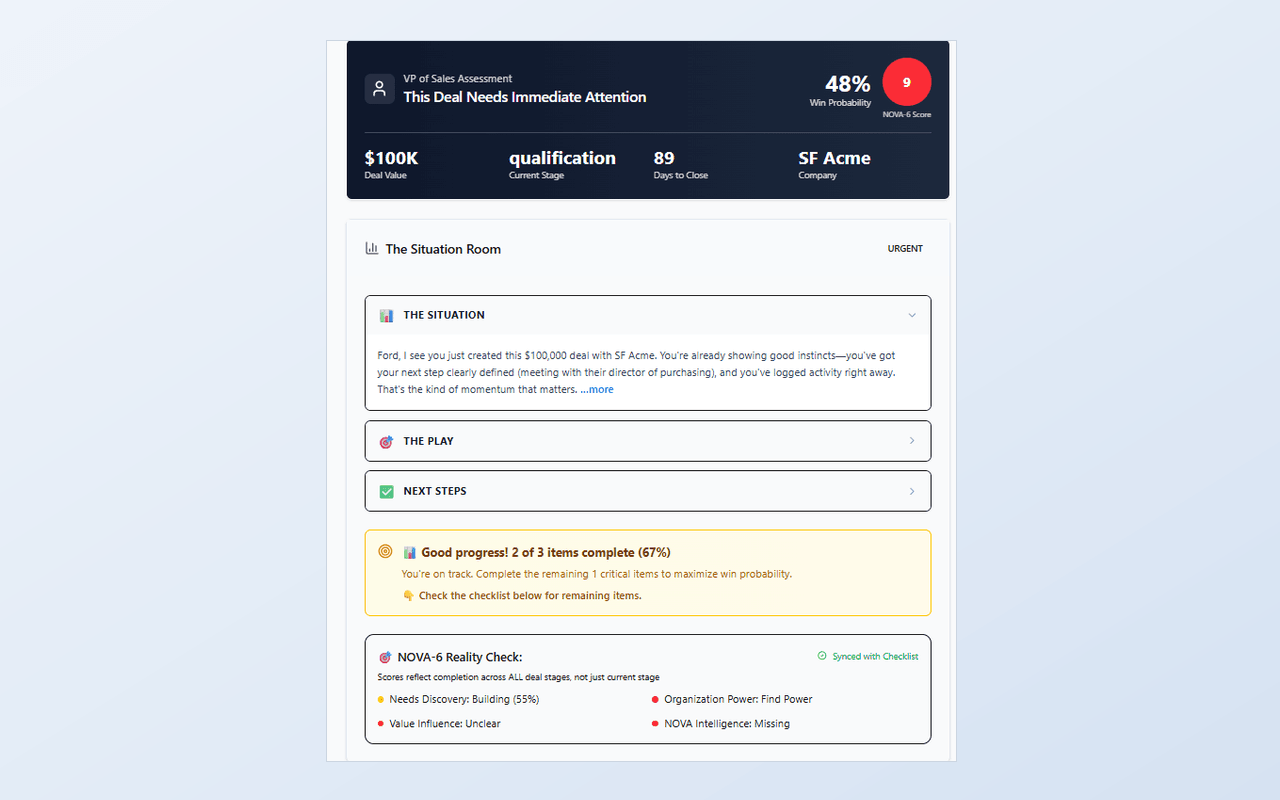
I run this through the six dimensions of NOVA-6, because "this deal feels soft" is not something I can act on and "you have no Organization Power on this one" is. The dimensions I am checking on every commit are Needs Discovery, Organization Power, Value Influence, Alignment Strategy, Sixth Sense, and NOVA Intelligence. When I ask whether a deal belongs in the commit, I am really asking whether it holds up across those, not whether it has crossed some line on the board.
Here is the practice I would hand a rep on Monday.
- Make every commit defend itself. If a deal is in your commit, you owe one sentence on why, and the sentence has to point at something real. Confirmed economic buyer. A signed proposal in legal. A scheduled next step with a name attached. "It feels close" does not survive this question, and that is the point.
- Score health, then weight by it. Walk the six dimensions on each deal that matters. A deal with two weak dimensions and no recent contact does not get to carry full stage probability into your number, no matter how late it looks in the pipeline.
- Separate what you believe from what you can prove. I keep two buckets. Commit is what I can prove, the evidence is sitting right there. Best case is what I believe, the deal is strong but one piece is missing. Everything else is pipeline and I treat it like the long shot it is. Mixing belief into the commit is how the whole forecast rots.
- Re-qualify when a date slips, do not just move it. A pushed close date is a signal to reopen the deal, not to type a new month. Ask what changed. If nothing changed and it still slipped, that tells you the deal was never as healthy as the stage claimed.
- Keep score on yourself. Most teams track whether a rep hit quota and never track whether the rep forecast well. Those are different skills. When a committed deal slips, I want to know which dimension I ignored, because that is the one I will ignore again next quarter if I do not write it down.
The hardest part of this is not the scoring. It is sitting in a forecast call and saying out loud that your own deal in Negotiation is actually a best case, not a commit, because you still have not met the person who signs. I have had to do that in front of my boss more than once. It stings for an hour and saves you a quarter.
None of this gets you to perfect. Buyers change their minds, champions leave, budgets get frozen in a meeting you were never in. A forecast is a measurement of an uncertain thing, and the goal is an honest measurement, not a flattering one. We built Opsight to read deals across those six dimensions instead of one column, but you can do the core of this with a whiteboard and the discipline to ask why for every deal in the commit.
So before your next forecast call, try the smaller version of the question I now ask first: for each deal you are about to commit, what is the proof, and would it survive someone who does not want the deal to close?
The whole NOVA-6 framework is free: six dimensions, the exact questions elite reps ask, and a one-page blueprint you can pin to your desk.
Explore the free NOVA-6 academy →Key takeaways
- Stage measures process position, not deal strength. A deal in Negotiation with no economic buyer and no recent contact is not a high-probability deal.
- Reps distort the number in both directions, through happy ears and through deliberate sandbagging, so the raw stage probability cannot be trusted on its own.
- A close date that keeps getting pushed is a prompt to re-qualify the deal, not a prediction to roll forward.
- Weight your forecast by real deal health across the NOVA-6 dimensions, and make every committed deal defend itself with evidence.
- Keep your commit to what you can prove and your best case to what you believe, and track your own forecast accuracy, not just quota attainment.
Keep learning — free, no signup
The same field-tested playbook this article draws from, in the free Sales Academy.
Ashish Kohli
Ashish spent two decades carrying a sales quota and managing reps across wireless, B2B, and enterprise, and taught sales at the college level. He's building Opsight, an AI sales coach that adapts to how each rep actually sells instead of coaching everyone the same way.
Get the next one in your inbox
A short, practical note on sales coaching and deal health every week or two. No fluff, no spam, unsubscribe anytime.
No spam. Unsubscribe anytime.