
Deal Health: How I Read Whether a Deal Is Actually Alive
Stage tells you where a deal sits, not whether it can breathe. The signals I learned to read after losing deals I was sure of.
The deal that feels safest is usually the one I end up losing. Late stage, great demo, everyone nodded. Then it just sits there, and three weeks later I'm reading a polite email about budget freezes.
I spent about twenty years carrying a number before I started building software for it. The most expensive lesson in all of that was simple. A deal's stage and a deal's health are two completely different things, and I kept confusing them.
Stage is a label I put on a deal. Health is whether the deal can survive contact with a CFO, a competitor, or a champion who changes jobs. You can drag a card from Demo to Proposal in your CRM in two seconds. That motion proves nothing about whether the thing is breathing.
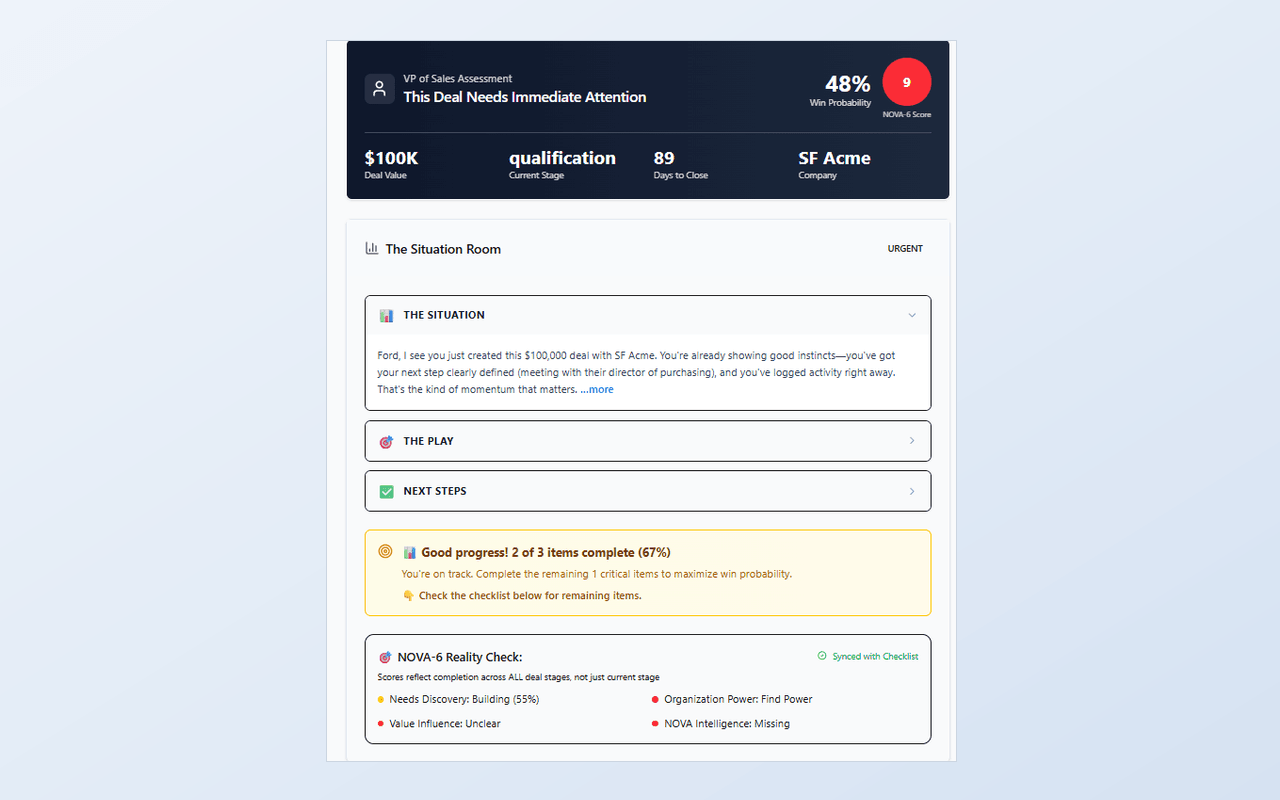
The vital-signs idea
I think of deal health the way a nurse thinks about a patient. Nobody walks into a room and says "this person is in the cardiology ward, so they're fine." They check pulse, temperature, oxygen, how the patient is actually responding right now. The ward is just location. The vitals are truth.
A deal has vitals too. They're quieter and easier to ignore, which is exactly why so many of us forecast deals that were already cold. Once I started reading the vitals instead of the stage, my pipeline got smaller and my close rate went up. Painful at first. Honest, though.
The signals I actually read
When I look at a deal now, I'm not asking what stage it's in. I'm asking a handful of harder questions.
How complete is the qualification? Do I genuinely understand the pain, who feels it, what it costs them to do nothing, and how they buy? Or do I have a stage of Proposal sitting on top of a discovery call where I did most of the talking? A deal can look advanced and be hollow underneath. That gap is where I've been burned the most.
When did something real last happen? Not an email I sent into the void. A reply, a meeting, a question from their side, a forwarded message to someone new. If the last meaningful exchange was eleven days ago and I'm the only one who's touched the keyboard since, the deal is drifting whether I admit it or not.
Is it moving at my normal speed? Every rep has a rhythm for how their good deals progress. When a deal that should take five weeks is sitting in the same stage for its third, that's a temperature reading. Slow isn't always fatal. It's always worth a second look.
Is there a concrete next step on the calendar? This one is almost unfair in how predictive it is. A specific meeting booked with a specific human for a specific reason means the deal has a future the buyer agreed to. "I'll follow up next week" is not a next step. It's hope wearing a calendar invite.
What do the notes actually say? My own words give me away. If my notes are full of "they loved it" and "great energy," I'm coaching myself to feel good. The useful notes are the ones with friction in them. Who pushed back. What they went quiet about. The offhand line about a competitor or a reorg that I'd rather not weight too heavily.
Why a stage-only pipeline lies to you
Most pipeline reviews I sat through, on both sides of the table, were a tour of stages. Twelve deals in Proposal, eight in Negotiation, a number at the bottom. Everyone nods. The number gets reported up. Then the quarter ends and half of Negotiation evaporates.
A stage-only view does three quiet bits of damage. It manufactures confidence in deals that haven't earned it, because a late stage looks like progress. It hides the deal that's technically early but genuinely strong, so I under-invest in the one I should be feeding. And it keeps me reactive, reaching for deals only when they're already slipping, which is the worst possible time to influence anything.
This is roughly why we built Opsight to read across six dimensions instead of one column. NOVA-6 looks at things like Needs Discovery, who actually holds Organization Power, whether real Value Influence exists, and the Alignment Strategy across the buying group, plus the softer Sixth Sense signals my own notes leak. The point isn't the framework. The point is that one axis was never going to tell me whether a deal could survive.
How the best teams use it
The teams that read deal health well do three practical things with it.
They prioritize their day around it. Most reps work their favorite deals, the ones that feel good to call. The better instinct is to work your lowest-health deals first, while there's still time to change the outcome. A green deal can wait a day. A yellow one might not survive the week.
They turn pipeline reviews into coaching. When a manager can see a deal is weak before the rep says a word, the conversation stops being an interrogation about the number. It becomes "your next-step is missing on these four, let's fix that today." That's the difference between a review the rep dreads and one that actually helps.
They forecast with less fiction. A commit built on health signals holds up better than one built on optimism and a calendar date. It's a quieter forecast. It's also the one I'd bet my own comp on.
Where to start this week
You don't need a system to begin. Open your pipeline and rate every open deal green, yellow, or red on instinct alone. Don't overthink the color. Then do the part that matters, which is forcing yourself to answer why for each one. Why is this red? Because there's no next step and I haven't heard from them in two weeks. Why is this green? Because the economic buyer asked me a procurement question unprompted.
That second question is the whole exercise. The color is just a prompt to make you say out loud what you already half-know. Most of the time the answer was sitting in your notes, the way mine was, waiting for someone to actually read it.
So here's what I'd ask before your next forecast call. If you stripped the stage labels off every deal and could only see the vitals, how many would you still be willing to commit?
The whole NOVA-6 framework is free: six dimensions, the exact questions elite reps ask, and a one-page blueprint you can pin to your desk.
Explore the free NOVA-6 academy →Key takeaways
- Stage is a label you control; health is whether the deal can survive a real test. Don't confuse the two.
- The signals that matter: how complete the qualification really is, when something meaningful last happened, whether it's moving at your normal speed, whether a concrete next step is booked, and what your own notes quietly reveal.
- Stage-only pipeline views breed false confidence, hide your strong early deals, and keep you reactive.
- Strong teams work their lowest-health deals first, turn pipeline reviews into coaching, and forecast with fewer fairy tales.
- Start tonight: rate each deal green, yellow, or red on gut, then force yourself to explain why. The answer is usually already in your notes.
Keep learning — free, no signup
The same field-tested playbook this article draws from, in the free Sales Academy.
Ashish Kohli
Ashish spent two decades carrying a sales quota and managing reps across wireless, B2B, and enterprise, and taught sales at the college level. He's building Opsight, an AI sales coach that adapts to how each rep actually sells instead of coaching everyone the same way.
Get the next one in your inbox
A short, practical note on sales coaching and deal health every week or two. No fluff, no spam, unsubscribe anytime.
No spam. Unsubscribe anytime.