
Why the Same Coaching Advice Helps One Rep and Hurts Another
You give two reps the same advice and get opposite results. It is almost never about effort. It is about how each rep is wired, and how you coach for it.
Most sales managers have one coaching style. Their own. It is the style that worked when they carried a bag, so it feels like the right one. The problem shows up quietly, in the half of the team it does not fit.
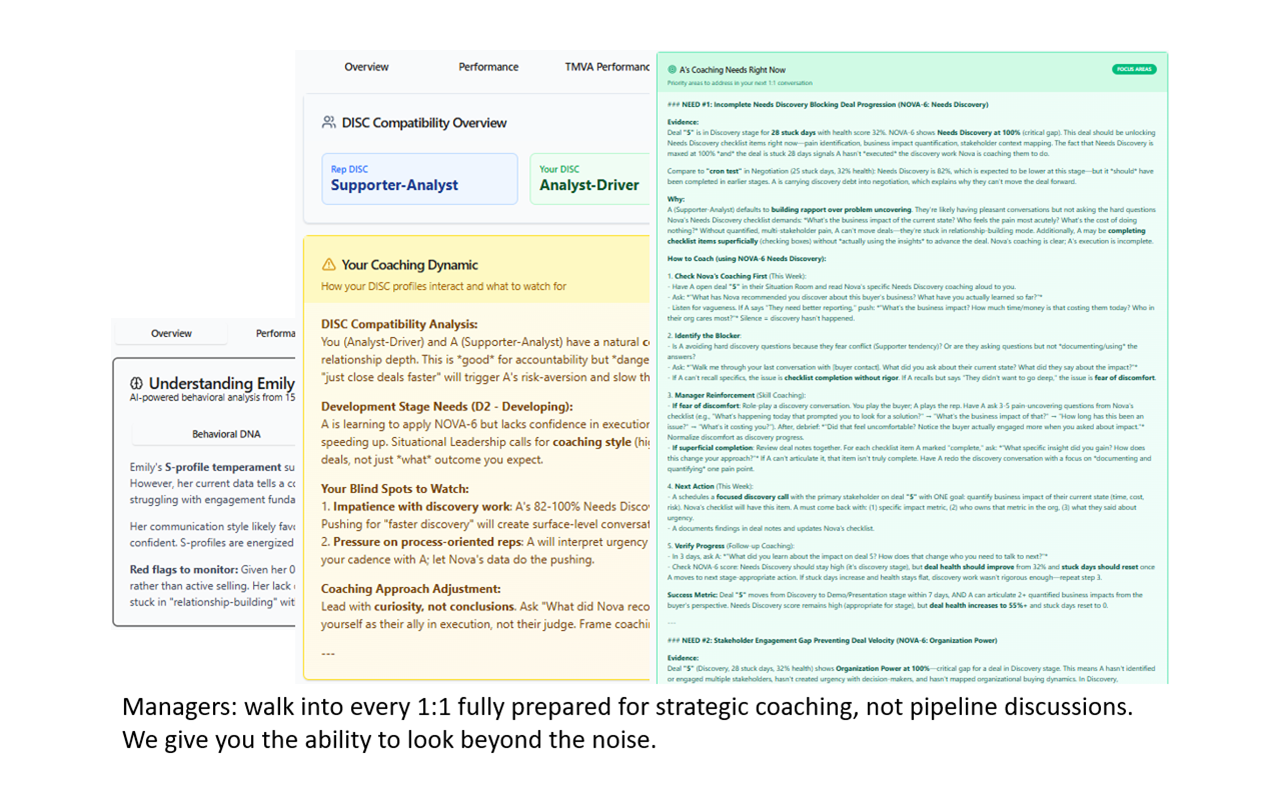
The pattern every manager has run into
You give two reps the same advice in the same week. One of them takes off. The other gets quieter, slower, a little defensive. Same words, opposite result.
The easy explanation is that the second rep has a worse attitude or less talent. Usually that is wrong. They are just wired differently, and the advice that fit you did not fit them.
I spent years coaching everyone the way I wanted to be coached. High energy, direct feedback, decide fast and move. It worked great on the reps built like me. It flattened the ones who were not.
DISC is a map for how someone decides under pressure
DISC gets dismissed as a personality quiz, the kind of thing you do at an offsite and forget by Monday. That sells it short. For a sales manager it is one of the most practical lenses you have, because it tells you how a rep takes in information and how they decide when a deal is on the line.
Four broad wirings:
- D (Dominance): moves on urgency and control. Wants the headline, the decision, the next move.
- I (Influence): moves on enthusiasm and people. Sells on energy, story, and social proof.
- S (Steadiness): moves on trust and stability. Wants context, reassurance, and time to prepare.
- C (Conscientiousness): moves on logic and accuracy. Wants the data, the process, and room to think.
None of these is the good one. Your best closer and your most reliable forecaster are probably different letters.
The same sentence, four translations
Here is why generic advice bounces. The words leave your mouth meaning one thing and land meaning another.
- "Slow down and build rapport." A D-style rep hears go soft.
- "Trust your gut on this one." A C-style rep hears be reckless.
- "Be more assertive." An S-style rep hears go burn a relationship.
- "Stick to the process." An I-style rep hears you are boring.
The advice was probably fine. It just was not shaped for the person sitting across from you. So they nod, walk out, and do nothing with it, and you both wonder why the coaching never takes.
The trap: you coach toward your own wiring
This is the part that is hard to see in yourself. Under time pressure, managers default to coaching the way they would want to be coached. A high-D manager pushes everyone to be more aggressive. A high-S manager tells everyone to slow down and build the relationship. You are not playing favorites on purpose. You are handing out your own operating manual to people who run on different hardware.
The reps who share your wiring start to look like your stars. The reps who do not look like projects. Often they are not projects. They are mistranslations.
What to do instead
You do not need a certification. You need to diagnose the wiring before you prescribe the fix.
- Watch how they decide, not just what they produce. Does the rep want the answer in thirty seconds, or do they want to think out loud first? Do they get energy from the room, or from being left alone to prepare? That tells you more than their pipeline number.
- Translate the advice into their language. The C-style rep who is slow to follow up does not need a pep talk. They need a simple rule and the reason behind it. The D-style rep who skips discovery does not need a lecture on empathy. They need to see how skipping it costs them the deal.
- Change the cadence, not just the content. A D wants you direct and brief. An S wants you to slow down and build their confidence before the call. Same coaching point, delivered at the speed the rep can actually use.
- Coach to the wiring, not against it. The goal is not to turn a steady rep into a hard charger. It is to make them a sharper version of who they already are.
Why this beats another framework
Most coaching advice is generic on purpose, because generic scales. The trouble is that generic advice gets averaged across a team of individuals, and the average fits almost no one. When you coach to a rep's wiring, they stop fighting themselves. The follow-up improves, the discovery gets deeper, the forecast gets honest. Not because the rep became someone else, but because you finally stopped asking them to.
The whole NOVA-6 framework is free: six dimensions, the exact questions elite reps ask, and a one-page blueprint you can pin to your desk.
Explore the free NOVA-6 academy →Key takeaways
- The same advice lands differently because reps take in information and decide differently. DISC is a practical map for that.
- Under pressure, managers coach toward their own wiring. The reps who do not match start to look like underperformers when they are really mistranslations.
- Diagnose how a rep decides before you prescribe. Translate the advice, adjust the cadence, and coach to the wiring instead of against it.
Keep learning — free, no signup
The same field-tested playbook this article draws from, in the free Sales Academy.
Ashish Kohli
Ashish spent two decades carrying a sales quota and managing reps across wireless, B2B, and enterprise, and taught sales at the college level. He's building Opsight, an AI sales coach that adapts to how each rep actually sells instead of coaching everyone the same way.
Get the next one in your inbox
A short, practical note on sales coaching and deal health every week or two. No fluff, no spam, unsubscribe anytime.
No spam. Unsubscribe anytime.