
Stop Running Your 1:1s Like Pipeline Interrogations
Most weekly 1:1s are status checks reps brace for and learn nothing from. Here is how to run one that actually develops the rep.
Picture the standard weekly 1:1. Manager opens the pipeline report. "Where are we on Acme? What about Globex? Did you get the signature on Initech yet?" The rep reads numbers back off a screen the manager is also looking at. Thirty minutes later everyone leaves and nothing about the rep changed.
I ran that meeting for years before I noticed what it actually was. It was inspection. I was checking my own forecast, dressed up as a conversation about my people. The rep knew it too. They came in with their answers pre-loaded, said the safe version of everything, and left exactly as good as they walked in.
Reporting and coaching feel similar because they happen at the same table with the same deals on screen. They are not the same job. One protects your number for this quarter. The other builds a rep who hits their number for the next eight.
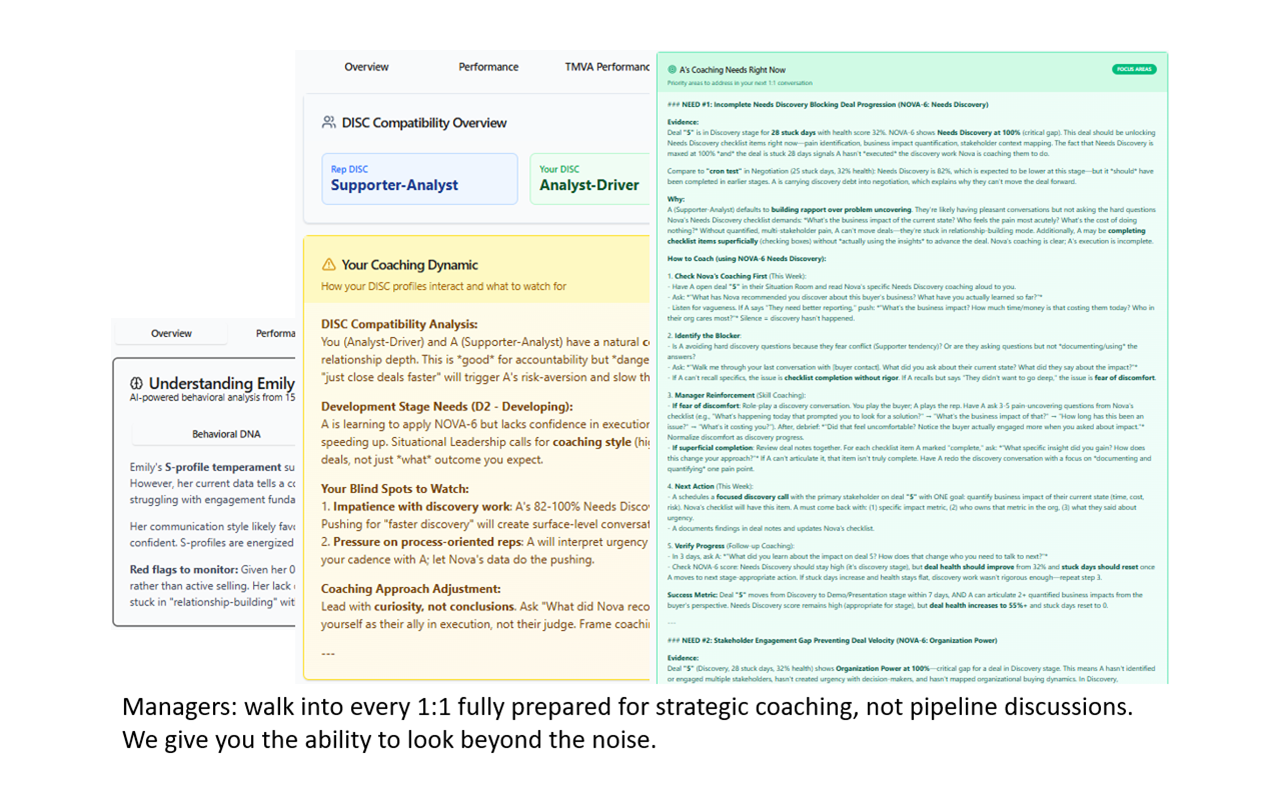
Why the interrogation fails
Status questions train reps to manage you. When the first thing out of your mouth every week is "what's the latest," the rep's whole prep becomes anticipating that question. They get good at sounding on top of it. They do not get good at selling.
There is also a trust cost. A pipeline interrogation puts the rep on defense before they sit down. Defensive people do not think out loud, and thinking out loud is where coaching happens. If your rep is performing confidence for you, you will never see the spot where they are actually stuck. That spot is the entire point of the meeting.
And you already have the status. It is in the CRM. Asking a person to narrate data you can read yourself is the least valuable thing you can do with thirty minutes of their attention.
Do the homework before they walk in
This is the unglamorous part that changes everything else. Before the 1:1, open the rep's deals yourself. Read the recent notes. Look at what moved and what stalled. Come in already knowing the status so you never have to ask for it.
Fifteen minutes of prep buys you the whole meeting back. Now the conversation can start at "I read the Acme thread, walk me through why the champion went quiet" instead of "what's happening with Acme." One of those is a coach who showed up. The other is a manager who wants a report.
While you read, you are hunting for one thing.
Pick one pattern, not ten deals
The instinct is to go deal by deal and touch everything. Resist it. You will skim the surface of eight deals and develop nothing. Instead, look across the rep's deals for a pattern that repeats.
Maybe every deal has a nice technical contact and no real economic buyer. Maybe they all have strong rapport and no agreed cost of doing nothing. Maybe the rep keeps creating great first meetings that never get a committed second step. The pattern is the lesson. One pattern, taught well, transfers to every deal they will ever run. Eight status updates transfer to nothing.
So the spine of the meeting becomes: here is the thing I noticed showing up in three of your deals, let's work on that.
Diagnose the weakness with NOVA-6
Once you are looking for patterns instead of statuses, you need a shared language for where a deal is actually weak. I use the six dimensions of NOVA-6, because "this deal feels soft" is not coachable and "you have no Organization Power on this one" is.
- Needs Discovery. Do we understand the real problem, or just the surface ask? Most stalled deals I see are discovery debt coming due.
- Organization Power. Do we have access to someone who can actually spend money, or only someone who can say no?
- Value Influence. Has the buyer connected what we do to a number they care about? Or do they like us without being able to justify us?
- Alignment Strategy. Is there a real mutual plan to a decision, or a hopeful sequence of follow-ups?
- Sixth Sense. What is the rep's gut telling them that the CRM does not say? That instinct is data, and it is worth pulling out loud.
- NOVA Intelligence. What signal are we ignoring? A delayed reply, a new name on the thread, a sudden urgency. The deal is talking.
When you read the rep's deals through these, the weak dimension usually jumps out and it tends to repeat. That repetition is your one pattern. You did not have to invent it. The deals handed it to you.
Ask questions that build thinking, not questions that extract updates
The verb matters more than people think. An extraction question pulls information toward you. A building question makes the rep reason in front of you.
Extraction sounds like "did you send the proposal." Building sounds like "if the deal stalls next week, where does it die, and what would you have wanted to know sooner." The first gets you a yes. The second makes the rep run the deal forward in their head while you watch, which is the only way you find out how they actually think.
A few that earn their place:
- "What does this buyer believe right now that has to change before they sign?"
- "Who in that account benefits if we lose, and what are they doing about it?"
- "If you only got one more meeting, what would you have to accomplish in it?"
Notice none of those can be answered from the pipeline report. They force the rep to think, and your job in the quiet that follows is to shut up and let them.
Deliver it the way the rep is wired
Same diagnosis, four different deliveries. This is where DISC earns its keep, because the right insight delivered in the wrong dialect bounces off.
- A D rep wants the headline and a challenge. "You're losing on power, not product. Fix your access by Friday." Brevity reads as respect.
- An I rep wants it as a story and a shared win. Make the pattern feel exciting to solve, not like a deficiency report.
- An S rep wants safety and a plan. Slow down, frame it as practice, give them a concrete next step so the change feels low risk.
- A C rep wants the evidence. Show them the three deals where the pattern appears and let the data make your case before you do.
The structure you can run Tuesday
Here is the whole thing in order, short enough to keep on a sticky note.
- Prep, ten to fifteen minutes. Read the deals so you never ask for status.
- Open with the pattern. "Here's the one thing I want to work on with you today."
- Diagnose with NOVA-6. Name the weak dimension so it is specific and shared.
- Build, don't extract. Ask the questions only the rep can answer, then go quiet.
- Deliver to their wiring. Same insight, their DISC dialect.
- Leave one rep, leave one change. End with a single concrete thing they will do before next week.
The forecast review still has to happen. Just stop pretending it is coaching, and stop spending your best half hour on it. Move the status check to a Slack message or a shared doc, and protect the 1:1 for the only thing it is uniquely good for, which is making the person sitting across from you better at the job.
So the question I would sit with before your next round of 1:1s is a simple one. If you took the pipeline report off the table entirely, would you still know what to talk about?
The whole NOVA-6 framework is free: six dimensions, the exact questions elite reps ask, and a one-page blueprint you can pin to your desk.
Explore the free NOVA-6 academy →Key takeaways
- A 1:1 built around status questions is inspection, not coaching, and reps learn to manage you instead of learning to sell.
- Read the rep's deals before the meeting so you never spend the conversation asking for data you could read yourself.
- Pick one pattern that repeats across their deals instead of touching every deal shallowly. The pattern is the lesson.
- Use the NOVA-6 dimensions to name exactly where a deal is weak, so the gap is specific and coachable.
- Ask questions that make the rep think out loud rather than ones that extract an update, then stay quiet.
- Deliver the same diagnosis in the rep's DISC dialect, because the right insight in the wrong style bounces off.
Keep learning — free, no signup
The same field-tested playbook this article draws from, in the free Sales Academy.
Ashish Kohli
Ashish spent two decades carrying a sales quota and managing reps across wireless, B2B, and enterprise, and taught sales at the college level. He's building Opsight, an AI sales coach that adapts to how each rep actually sells instead of coaching everyone the same way.
Get the next one in your inbox
A short, practical note on sales coaching and deal health every week or two. No fluff, no spam, unsubscribe anytime.
No spam. Unsubscribe anytime.