
NOVA-6: The Sales Framework I Distilled From 20+ Years in the Field
NOVA-6 is the field-tested system I built across two decades of selling. Six dimensions that tell you, on any deal, where to spend your next hour.
I have lost deals I should have won. Not because I missed the steps, but because I knew them and skipped them when I got busy. That gap, between what a seller knows and what a seller does on a Tuesday afternoon with eleven open opportunities, is the thing NOVA-6 is built to close.
I spent more than twenty years carrying a quota and running teams. Somewhere in the middle of that I stopped trusting my memory and started writing down what separated the deals that closed from the ones that stalled. NOVA-6 is what those notes turned into. Six dimensions. A way to score where each deal actually stands. And a habit you can run on every opportunity, even the ones you would rather not look at.
Why I needed a framework at all
For a long time I thought experience was the framework. Do this enough and you just feel where a deal is soft. The problem is that the feeling shows up too late, usually in the forecast meeting when someone asks why a sure thing slipped a quarter. By then the soft spot has been soft for weeks.
What I wanted was something that told me what to do next on the deal in front of me, before the slip, without asking me to pick between a stack of overlapping playbooks. Each dimension in NOVA-6 gets a score. Your two lowest scores are the answer to the only question that matters on a Tuesday: where does my next hour go?
The six dimensions
N. Needs Discovery
How well you understand where the buyer is now, where they want to be, and the size of the gap between those two. The part most reps miss is the personal stake sitting under the business problem. Someone owns this number, and something happens to that person if it does not move.
What strong looks like:
- You documented the current state with real specifics, not adjectives
- You quantified the impact in the buyer's own numbers
- You reached the personal stake, not just the business case
- You found the problem behind the problem they first told you about
O. Organization Power
Whether you actually understand who decides, and whether you have access to them. I have watched flawless deals die because the rep sold beautifully to the wrong person, or to the right person who had no support inside their own building.
What strong looks like:
- You mapped the org and the real influence lines
- You can name the economic, user, and technical buyers
- You built an executive sponsor who wants this to happen
- You understand the informal power, which rarely matches the chart
V. Value Influence
Your ability to make change feel urgent and inaction feel expensive. A good product does not create a deal. The deal exists when staying put costs more than moving.
What strong looks like:
- You made the cost of doing nothing concrete and specific
- You found or helped create a compelling event with a date attached
- You framed the return in the buyer's language, not yours
- You built a business case that holds up in the room when you are not in it
A. Alignment Strategy
How much consensus you have built across the buying group. In serious B2B deals one champion is a single point of failure. Different stakeholders want different things, and the deal moves when those wants stop pulling against each other.
What strong looks like:
- You are multi-threaded across several real stakeholders
- You tailored the message to what each persona actually cares about
- You surfaced the political obstacles early, while they were still small
- You built the coalition before you asked anyone for a decision
6. Sixth Sense
The part that does not fit in a field. Trust, credibility, rapport, and the read on a room. This is why a buyer picks you when the competing product has the same features at the same price.
What strong looks like:
- You built genuine rapport that goes past the agenda
- You showed real domain expertise, not a memorized pitch
- You heard what was said and noticed what was carefully avoided
- You have a relationship that survives your main contact leaving
+. NOVA Intelligence
How well you use data and pattern to sharpen the rest. After enough deals you stop guessing and start recognizing. This deal looks like three you have seen before, and two of them you lost the same way.
What strong looks like:
- You prioritize by real probability, not by what is loudest in your inbox
- You recognize the patterns from your own wins and losses
- You reuse the plays that have worked in situations like this one
- You adapt instead of running the same motion on every account
How the scoring earns its keep
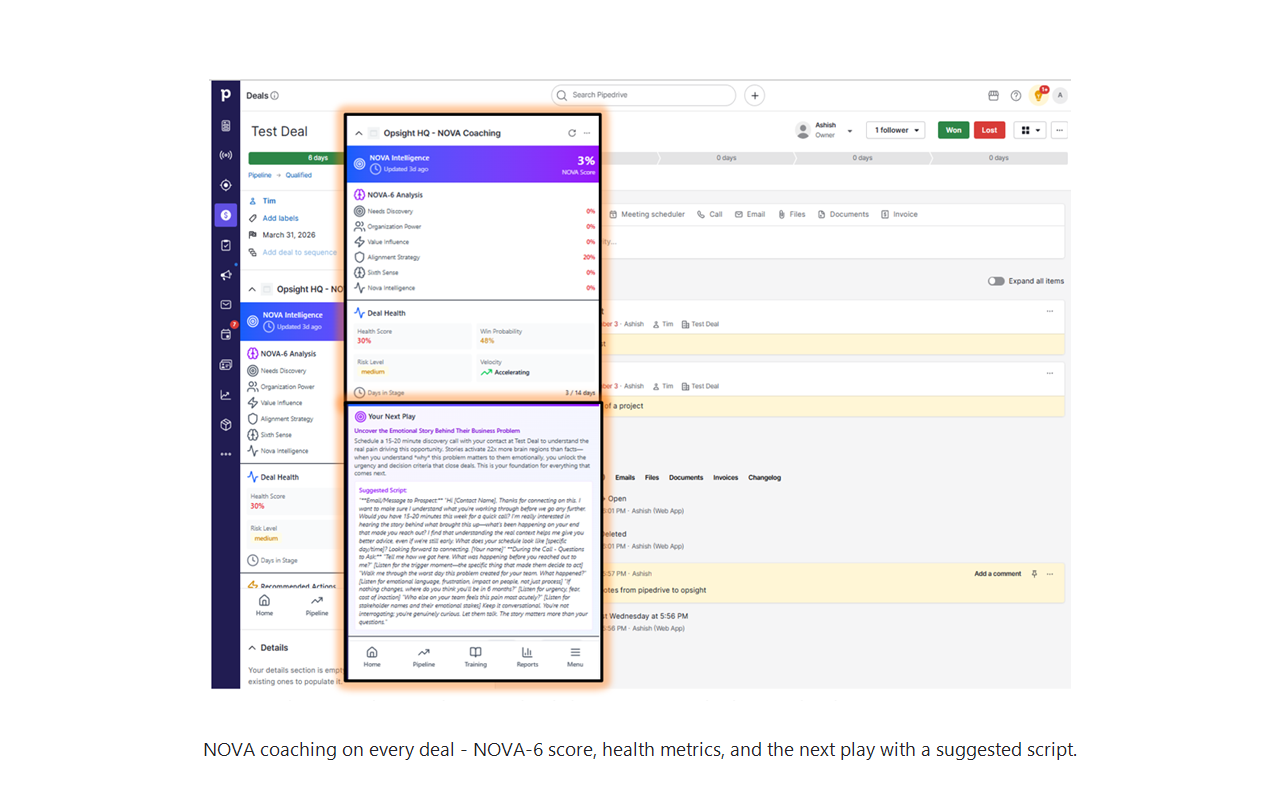
Each dimension gets a score. On its own a number does not coach anyone. The value is in the shape across all six, because the gaps tell a story.
High Organization Power and low Needs Discovery means you are talking to exactly the right people about a problem you have not made real yet. You have access and no pain. High Needs Discovery and low Alignment Strategy is the opposite trap. You have done beautiful work with one person and built nothing around them, so the deal lives and dies on a single calendar.
Running it without any software
We build NOVA-6 scoring into Opsight so it happens on every deal automatically, but you do not need us to start. You need a list of your open deals and twenty quiet minutes.
- For each active deal, rate yourself one to five on every dimension
- Circle your two lowest scores on each deal
- Write down one specific action that moves each of those this week
- Do it again next week and watch which numbers refuse to climb
The numbers that refuse to climb are worth paying attention to. A dimension that stays low after three weeks of effort is usually not a skill gap. It is the deal telling you something you have not wanted to hear. So the real question is not whether you can score your pipeline this way. It is whether you will keep looking once a score tells you the deal you have been counting on was never as close as it felt.
The whole NOVA-6 framework is free: six dimensions, the exact questions elite reps ask, and a one-page blueprint you can pin to your desk.
Explore the free NOVA-6 academy →Key takeaways
- Most deals are lost to inconsistency, not ignorance. NOVA-6 exists to close that gap.
- The six dimensions are Needs Discovery, Organization Power, Value Influence, Alignment Strategy, Sixth Sense, and NOVA Intelligence.
- Score each dimension. Your two lowest scores tell you where the next hour should go.
- The combinations matter more than any single number, like strong discovery paired with weak alignment.
- You can run the whole thing on a list of deals and twenty minutes a week, no software required.
Keep learning — free, no signup
The same field-tested playbook this article draws from, in the free Sales Academy.
Ashish Kohli
Ashish spent two decades carrying a sales quota and managing reps across wireless, B2B, and enterprise, and taught sales at the college level. He's building Opsight, an AI sales coach that adapts to how each rep actually sells instead of coaching everyone the same way.
Get the next one in your inbox
A short, practical note on sales coaching and deal health every week or two. No fluff, no spam, unsubscribe anytime.
No spam. Unsubscribe anytime.