
Pipeline Reviews Are Not Coaching
Most leaders think they coach. Mostly they inspect deals. Here is the difference, why it gets blurred, and how to actually develop a rep.
Ask a sales leader if they coach their team and almost all of them say yes. Then sit in the meeting they call coaching. It is a status update with better lighting.
I ran these meetings for years before I understood what I was actually doing. Tuesday, a conference room, eight reps, a spreadsheet on the screen. We went deal by deal. What stage is Acme in. When does it close. Did you get to the economic buyer yet. Push it to next quarter or leave it. By the end I felt productive. I had a cleaner forecast and a tighter number to give my VP.
But none of my reps got better that day. Not one. I had inspected eight pipelines and developed zero people, and I had called it coaching the whole time.
Two different jobs wearing the same badge
Inspection is about the deal. Coaching is about the rep. That sounds small. It changes everything.
When I inspect, I am pointed backward. What happened on the Acme call. Why did the champion go quiet. Is the number real. Every question I ask is in service of predicting an outcome that is mostly already decided. The deal is the deal. By the time it shows up on the board, the discovery is done, the wrong person has been courted, the value never landed. I am reading a result.
When I coach, I am pointed forward. I am not asking what the number is. I am asking what skill my rep is missing, and what they should try on the next call so that the next ten Acmes go differently. The deal in front of us is just evidence. The rep is the subject.
Here is the test I use now. After the meeting, ask what changed. If the only thing that changed is your confidence in the number, you inspected. If the rep walks out able to do one thing they could not do an hour ago, you coached. Most of us, if we are honest, have run a hundred of the first kind and called them the second.
Why we fuse them
Two reasons, and both are sympathetic.
First is time. You get one hour a week with each rep if you are lucky, and the forecast is due Friday. The number has a deadline. The rep's growth does not. So the urgent eats the important, every single week, and after a few months the calendar has trained everyone that this meeting is about the number.
Second is that inspection feels like work. It is concrete. There are deals to move, dates to set, a board that looks different at the end. Coaching feels softer and slower. You spend forty minutes on one rep and one skill and there is nothing on a spreadsheet to show for it. So we reach for the thing that gives us a visible result, and we tell ourselves the questioning is developmental because we asked a lot of questions.
Pushing on a close date is not a question that develops anyone. It is pressure dressed as curiosity.
Fusing them makes both worse
When you mix the two, the forecast review bloats. You wanted to be developmental, so you linger on each deal, and now the meeting runs ninety minutes and the data is still soft.
And the coaching never happens, because coaching cannot survive in a room where everyone is bracing for the close-date interrogation. A rep who is defending a number will not tell you the truth about the call where they froze on pricing. They will manage you instead. They will give you the version that protects the deal. You lose the honesty that any real coaching depends on, and you do not even get a clean forecast in exchange.
How to separate them
Keep the forecast review short and boring. Twelve, fifteen minutes. Data only. What moved, what slipped, what is committed. No teaching, no soul-searching, no pep talk. The more mechanical you make it, the less it leaks into the rest.
Then start a different meeting, with a different posture, on one rep and one skill at a time.
The trick is choosing the skill well, and you do not find it by staring at a single deal. One lost deal is noise. You find a coachable skill by looking across a rep's deals for the thing that keeps breaking in the same place. The pattern is the lesson.
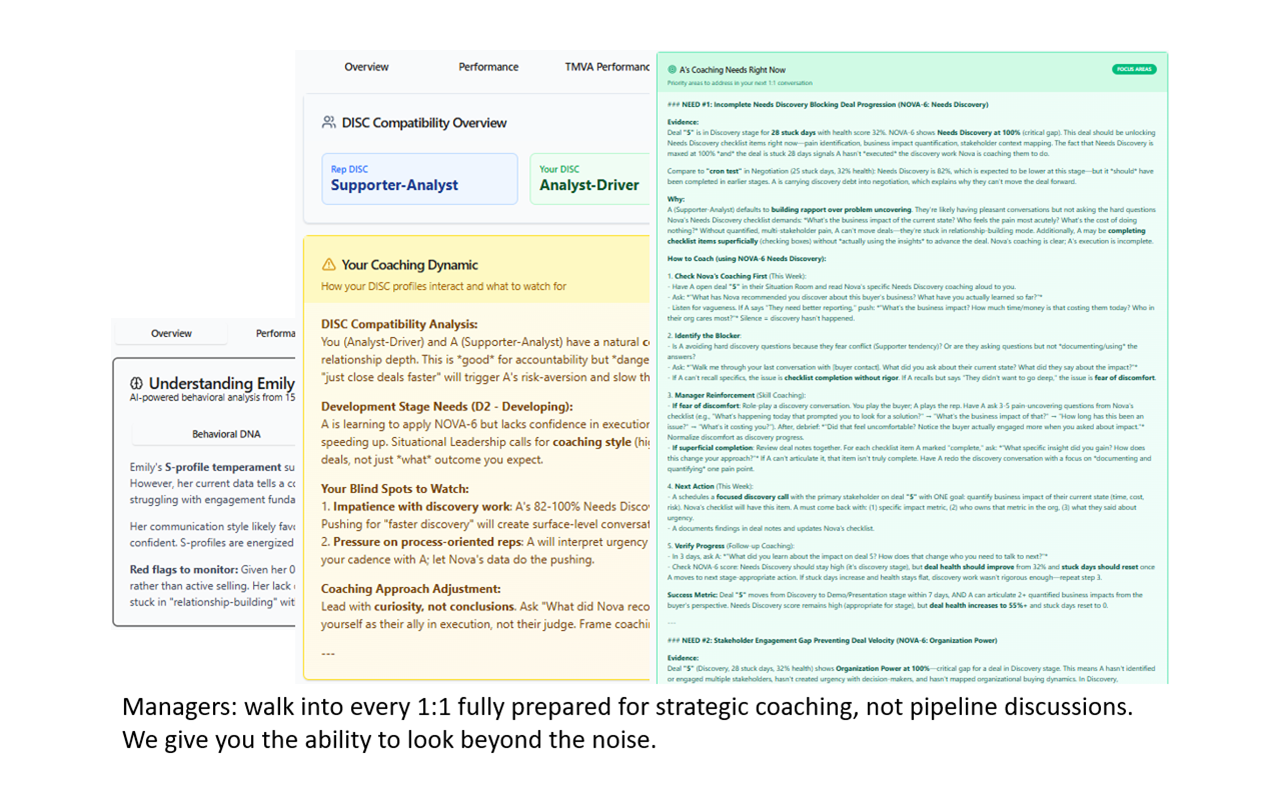
This is the lens I think in now, and it is the spine of what we build into Opsight. There are six places a deal tends to break, and a rep usually has one or two they keep dropping:
- Needs Discovery. They present before they understand the problem.
- Organization Power. They sell to the friendly contact, not the person who can actually sign.
- Value Influence. They describe features instead of making the buyer feel the cost of staying put.
- Alignment Strategy. They run their process, not the buyer's. No shared plan to a decision.
- Sixth Sense. They miss the quiet signals, the stalls and the soft no's, until it is too late.
- NOVA Intelligence. They do not adjust, running the same approach in every room regardless of who is across the table.
When you look at five of a rep's deals and four of them died right after the demo with a buyer who went dark, you are not looking at four flukes. You are looking at one missing skill showing up four times. That is what you coach next, and you coach only that, until it moves.
How you deliver it matters as much as what you pick. A blunt, fast rep wants the gap named in one line. A careful rep wants the room to think out loud. The same feedback lands as a gift or an insult depending on how the person in front of you is wired. Coach the rep you have, not the rep you would be.
None of this is harder than what you already do on Tuesdays. It is the same hour, cut differently. Twelve minutes on the deals, the rest on one human being and one thing they could do better. The forecast was always going to be the forecast. The rep is the only part of that meeting you can actually change.
So here is the question I would sit with. If you canceled your pipeline review tomorrow and the number still came in, what exactly would your team have lost?
The whole NOVA-6 framework is free: six dimensions, the exact questions elite reps ask, and a one-page blueprint you can pin to your desk.
Explore the free NOVA-6 academy →Key takeaways
- Inspection is about the deal and points backward; coaching is about the rep and points forward. Most "coaching" is inspection.
- The honest test: if only your confidence in the number changed, you inspected. If the rep can now do something they could not, you coached.
- Time pressure and the visible-result feeling fuse the two, which bloats the forecast and kills the honesty coaching needs.
- Run a short, dry forecast review, then a separate conversation on one rep and one skill.
- Find the skill in the pattern across a rep's deals, not in any single loss, and deliver it the way that rep is wired to hear it.
Keep learning — free, no signup
The same field-tested playbook this article draws from, in the free Sales Academy.
Ashish Kohli
Ashish spent two decades carrying a sales quota and managing reps across wireless, B2B, and enterprise, and taught sales at the college level. He's building Opsight, an AI sales coach that adapts to how each rep actually sells instead of coaching everyone the same way.
Get the next one in your inbox
A short, practical note on sales coaching and deal health every week or two. No fluff, no spam, unsubscribe anytime.
No spam. Unsubscribe anytime.